
Formulation Insights
Austrade Inc.
Austrade Inc.
What Is the Difference Between Dextrose and Maltodextrin?
Quick Answer
The primary difference between dextrose and maltodextrin is their molecular structure and functionality. Dextrose is a monosaccharide sugar that contributes sweetness and immediate energy, while maltodextrin is a polysaccharide that contributes bulk, texture, carrier functionality, and controlled carbohydrate delivery with minimal sweetness. In simple terms, dextrose provides sweetness and rapid energy, while maltodextrin provides bulk, texture, and functionality with minimal sweetness.
| Attribute | Dextrose | Maltodextrin |
| DE Value | 100 | <20 |
| Sweetness | High | Low |
| Function | Sweetener & energy source | Bulking, carrier, texture |
| Browning Potential | High | Low |
| Applications | Beverages, confectionery, bakery | Protein powders, seasonings, dry blends |
The dextrose vs. maltodextrin decision comes up constantly in food and beverage formulation — and it’s rarely as simple as it looks on a spec sheet. When customers ask us to swap one for the other in a dry beverage blend, the first question we ask is: what do you actually need this ingredient to do?
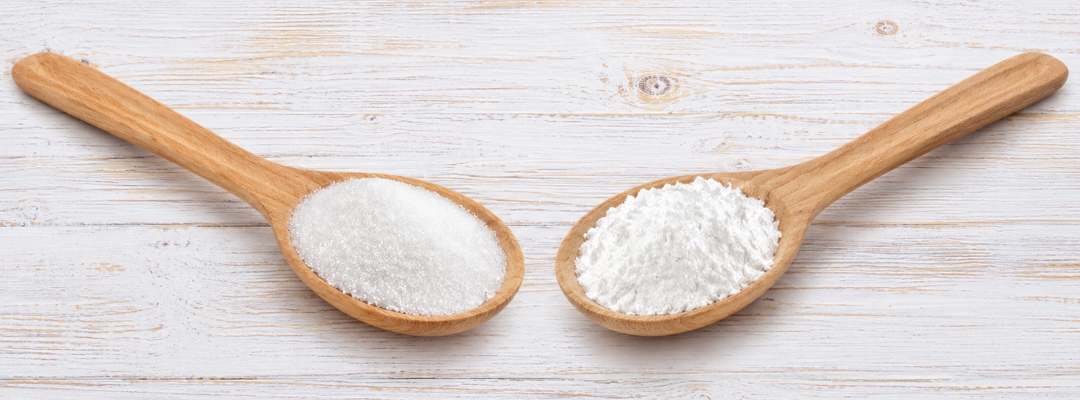
The confusion is understandable. Both appear as white, free-flowing powders with similar solubility profiles. However, in a food matrix, DE ~100 and DE <20 exhibit fundamentally different functional properties. Replacing dextrose with maltodextrin in a dry blend often results in lower perceived sweetness, reduced browning potential and slower fermentation behavior. Replacing maltodextrin with dextrose in a spray-dried system usually means encapsulation failure — dextrose’s crystalline structure doesn’t form a stable amorphous matrix around the active or flavor. These aren’t subtle differences that emerge at the margins; they show up within the first two trial runs.
Austrade has been supplying certified organic and non-GMO plant-based ingredients to food and beverage manufacturers since 1997. Consequently, the dextrose vs. maltodextrin question is one we field constantly — from R&D teams at CPG brands, contract manufacturers, and private label developers who face carbohydrate decisions that look simple on paper and get complicated in development.
How the Decision Differs by Application
For protein powder brands, the decision usually comes down to sweetness headroom. Specifically, at inclusion rates of 5–15%, maltodextrin in the DE 10–18 range adds body and improves mouthfeel without contributing perceptible sweetness — which matters in flavored systems where the sweetness balance is already locked by the flavor system and sweetener blend. Dextrose at equivalent inclusion rates shifts that balance measurably.
For sports nutrition formulators, carbohydrate selection is often a label claim decision as much as a formulation one. Dextrose — as a direct glucose equivalent — supports on-label claims around rapid carbohydrate delivery in a way that maltodextrin’s oligosaccharide structure complicates, since maltodextrin must first be cleaved to glucose during digestion before uptake occurs. That distinction matters when a product’s functional positioning depends on absorption timing.
For bakery and confection teams, the difference is visible in two places: the Maillard reaction and water activity management. Dextrose, as a free reducing sugar, participates directly in browning and contributes to crust development and flavor depth. Maltodextrin, by contrast, does neither — but it allows formulators to adjust bulk and texture in reduced-sugar systems without disturbing water activity targets the way sucrose or dextrose substitutions typically do.
Finally, for the question of whether maltodextrin is “bad for you”: formulators hear this from their consumers. It shows up in reviews, in label scrutiny on social media, and in retailer clean-label requirements. Therefore, knowing how each ingredient will likely be perceived — and why — is part of developing a product that holds up before and after launch.
~100
DE value of dextrose —
fully hydrolyzed starch
fully hydrolyzed starch
<20
DE value of maltodextrin —
partially hydrolyzed starch
partially hydrolyzed starch
9–19
Austrade maltodextrin
DE range available
DE range available
Dextrose vs. Maltodextrin: Key Differences Explained
Since both ingredients start from the same place (starch), the dextrose vs. maltodextrin difference comes down entirely to how far the hydrolysis goes.
Dextrose is the product of near-complete hydrolysis of starch into individual glucose molecules, landing at a Dextrose Equivalent (DE) of approximately 100. Maltodextrin is a partially hydrolyzed starch composed of short-chain glucose polymers (oligosaccharides), with a DE below 20 — typically in the 5–18 range.
The Food Chemicals Codex (FCC), published by the U.S. Pharmacopeia, defines the DE scale and serves as the primary industry reference for characterizing starch hydrolysates. A higher DE indicates more complete breakdown and greater sweetness; a lower DE, by contrast, reflects more structural complexity and broader functional utility as a carrier or bulking agent.
Austrade supplies maltodextrin across a DE range of 9–19, available in organic and non-GMO grades from corn, potato, and rice. The right DE for your system affects solubility rate, viscosity, and hygroscopicity — all of which shift meaningfully across the range.
Dextrose vs. Maltodextrin: How Dextrose Is Made
Manufacturers produce dextrose monohydrate via extensive enzymatic hydrolysis of starch, followed by purification, concentration, crystallization, and drying. The production process matters to formulators primarily because of what it determines downstream: DE consistency, residual moisture on delivery, and particle size distribution — all of which affect flow, solubility rate, and hygroscopic behavior in your system.
Functional Characteristics — Dextrose
DE: ~100; dextrose content ≥99.5%
Structure: Simple sugar (glucose)
Sweetness: High relative to maltodextrin; moderate relative to sucrose (~70%)
Fermentability: Rapid absorption; 100% fermentable
Austrade’s organic dextrose monohydrate is sourced from organic corn and produced by enzymatic hydrolysis. It carries Organic, Halal, and Kosher certifications and contains no known allergens. Dextrose (D-glucose) is affirmed as Generally Recognized as Safe (GRAS) by the FDA under 21 CFR §184.1857 and holds a monograph in the Food Chemicals Codex (FCC). It has also been evaluated by the Joint FAO/WHO Expert Committee on Food Additives (JECFA), which has established acceptable daily intake parameters consistent with its use as a food ingredient.
Formulation note on handling: Dextrose is hygroscopic. Above approximately 60% relative humidity, surface moisture absorption accelerates — leading to clumping, crystal fusion, or stickiness in finished dry blends. Storage below 25°C and 60% RH in sealed, moisture-barrier packaging is required. In open blending environments in humid climates, even short exposure windows during transfer or weighing can affect flowability, particularly at finer particle sizes.
How Maltodextrin Differs from Dextrose in Production
Unlike dextrose, which results from the near-complete hydrolysis of starch into glucose, maltodextrin is generated through controlled partial hydrolysis. This process produces a mixture of short-chain glucose polymers that give maltodextrin functional value as a carrier, texturizer, and stabilizing agent.
The Four-Step Production Process
1Starch gelatinization
2Enzymatic or acid hydrolysis
3Controlled breakdown to target DE (typically <20)
4Filtration, concentration, and spray drying
Functional Characteristics — Maltodextrin
Sweetness: Low to none
Flavor: Neutral
Solubility: Excellent
Primary function: Bulk, texture, carrier, and stability
The FDA classifies maltodextrin as GRAS under 21 CFR §184.1444, and the Food Chemicals Codex monograph defines its DE range, moisture limits, and purity specifications. Additionally, JECFA reviewed maltodextrin and found it acceptable for food use without an established numerical ADI — consistent with its long history of safe use across global food systems.
Austrade’s Maltodextrin Portfolio by Starch Source
Starch source influences functional performance in ways formulators must account for at the specification stage. Austrade’s maltodextrin portfolio spans DE 9–19 and is produced from three distinct starch sources:
→Corn Maltodextrin DE 19 (Non-GMO) — highly soluble and low-hygroscopicity; well-suited to beverages, dairy, and bakery applications where stability and neutral flavor are priorities
→Organic Corn Maltodextrin DE 10 (USDA Organic) — low-sweetness carrier and texturizer that enhances flowability, stability, and mouthfeel in powders and dry blends; applications include beverages, nutrition, and snacks
→Organic Corn Maltodextrin DE 19 (USDA Organic) — neutral-tasting carrier delivering excellent stability, flowability, and mouthfeel in both dry and liquid formulations; applications include beverages, dairy, and nutrition
→Potato Maltodextrin DE 9 (Non-GMO) — low-DE option with excellent encapsulation performance, minimal sweetness, and superior flavor neutrality; applications include soups, seasonings, and meat systems
→Rice Maltodextrin DE 18 (Non-GMO) — clean flavor, excellent solubility, and enhanced mouthfeel; applications include beverages, bakery, and confectionery
Formulation note on handling: Maltodextrin tends to cake in dry blends as water activity increases due to moisture uptake, particularly when formulators combine it with hygroscopic co-ingredients. In protein powder and meal replacement development, teams typically manage this through anti-caking agents, particle size optimization, or by sequencing the maltodextrin addition later in the dry blend process.
What Is Dextrose Equivalent (DE)?
DE measures the degree of starch hydrolysis on a scale from 0 to 100, as defined by the Food Chemicals Codex and referenced across JECFA and EFSA technical assessments:
Higher DE = More breakdown
More sweetness · More reactivity · Greater hygroscopicity
Lower DE = Less breakdown
More structural complexity · Better carrier function · Greater stability
In the dextrose vs. maltodextrin comparison, DE is the single most important number. Dextrose sits at ~100 DE. Maltodextrin falls below 20 DE. This difference explains why one behaves like sugar and the other functions as a texture and stability platform — and why they are rarely true substitutes for each other.
Key Differences Between Dextrose and Maltodextrin
| Attribute | Dextrose | Maltodextrin |
|---|---|---|
| Hydrolysis level | Near-Complete | Partial |
| DE value | ~100 | <20 |
| Structure | Single glucose molecule | Short glucose chains |
| Sweetness | Moderate (~70% relative to sucrose) | Low to none |
| Glycemic index | ~100 | ~85–110 (varies by DE and source) ¹ |
| FDA status | GRAS (21 CFR §184.1857) | GRAS (21 CFR §184.1444) |
| Primary function | Sweetener, fermentation substrate | Bulking, carrier, texture, stability |
| Relative cost | Lower | Moderate; varies by source and grade |
¹ Maltodextrin’s glycemic index can exceed that of dextrose because GI measures blood glucose response relative to a reference — not absolute glucose content. At lower DE values, the oligosaccharide chains in maltodextrin are rapidly cleaved during digestion, producing a fast and concentrated glucose release. Source and processing method also affect digestion rate. See: Atkinson, Foster-Powell & Brand-Miller, Diabetes Care, 2008.
What this means in plain language: Most people assume glucose — pure dextrose — sets the ceiling for how fast a carbohydrate raises blood sugar. Maltodextrin’s GI exceeding that ceiling is counterintuitive but technically explainable: when maltodextrin’s short glucose chains are cleaved during digestion, the resulting glucose is released in a concentrated, rapid wave. For formulators developing products with blood sugar or metabolic health positioning, this is the claim that requires the most careful handling on a label.
How Each Ingredient Performs Across Key Applications
Understanding dextrose vs. maltodextrin at the application level matters as much as the chemistry. Because dextrose is a reducing sugar, meaning each molecule has an available reducing end, it readily participates in Maillard browning reactions with amino compounds. In contrast, maltodextrin’s oligosaccharide chains have a lower density of available reducing ends, resulting in reduced Maillard reactivity. This makes it appropriate for applications where color stability or flavor neutrality is the priority.
Sports & Hydration Beverages
Dextrose is a standard fast-acting carbohydrate in isotonic drink formulations, where rapid glucose uptake is part of the product’s functional positioning. Maltodextrin, with its moderately slower digestion profile and neutral flavor, appears in endurance formats — often blended with dextrose — where sustained carbohydrate delivery matters more than immediate sweetness.
Spray-Dried Flavor & Nutrient Systems
Maltodextrin is the default carrier in encapsulation applications. Loading rates vary by active type: flavor systems generally run 10–20% maltodextrin by weight of the spray-dried matrix, while lipid encapsulation applications may reach 30–40% depending on emulsification requirements and target particle structure. For sensitive formulations requiring superior flavor neutrality, a low-DE option such as Potato Maltodextrin DE 9 is particularly well-suited. Dextrose is generally not a workable substitute in these applications; its hygroscopicity and crystalline structure undermine the encapsulation matrix.
Baked Goods & Dry Mixes
Dextrose drives Maillard browning and supports yeast activity in fermentation-dependent systems. Maltodextrin earns its place in reduced-sugar baked goods, where it provides bulk and texture without adding sweetness — useful when a formulation needs to hit a target water activity or improve mouthfeel without a sweetness increase on a reformulated label.
Protein Powders & Meal Replacements
Maltodextrin is widely used for bulking, mouthfeel, and texture. At inclusion rates of 5–15%, options in the DE 10–19 range add body without contributing perceptible sweetness. Rice Maltodextrin DE 18 is particularly effective for its clean flavor and enhanced mouthfeel in nutritional formulations. Dextrose may appear in post-workout recovery formats specifically for its glycemic response profile.
What Formulators Need to Know About Maltodextrin and Health
Maltodextrin’s glycemic index varies across literature due to differences in DE value and starch source — published estimates range from 85 to 110, and some studies place it above that of dextrose itself (Atkinson, Foster-Powell & Brand-Miller, Diabetes Care, 2008). Whether that range matters in a given formulation depends almost entirely on dose and application context.
At functional usage levels (typically <10% in most applications), maltodextrin contributes a modest glycemic load. At higher inclusion rates — as a primary carbohydrate source — formulators should label and position it accordingly, just as they would any high-GI ingredient.
Regulatory Status
Maltodextrin holds GRAS status under 21 CFR §184.1444. JECFA and the European Food Safety Authority (EFSA) have both reviewed it and found no established ADI restriction — a finding consistent with its long history of safe use across global food systems.
Gut Microbiome Research
Researchers have documented associations between maltodextrin intake and changes in gut microbiome composition, including enhanced adhesion of Crohn’s disease-associated E. coli strains (Nickerson & McDonald, PLOS ONE, 2012) and deregulation of intestinal anti-microbial defense mechanisms (Nickerson, Chanin & McDonald, Gut Microbes, 2015). Importantly, those studies used intake levels substantially higher than what a standard serving of a maltodextrin-containing product delivers at functional inclusion rates. Consequently, this is a consumer concern worth tracking — particularly for brands making gut health claims — but formulators should not treat it as a contraindication at standard food-use levels.
Allergen, Labeling & Clean-Label Considerations
Most commercial maltodextrin comes from corn, which matters for customers targeting corn-sensitive consumers. For allergen-sensitive formulations, Austrade offers rice and potato grades. Furthermore, under current FDA labeling rules, a U.S. ingredient declaration listing “maltodextrin” does not require starch source disclosure — though several brands now voluntarily specify the source (e.g., “rice maltodextrin”) to address consumer concerns proactively.
Maltodextrin’s classification under the FDA’s added sugars declaration is worth understanding precisely. Because it is primarily an oligosaccharide (DE <20), the ingredient itself does not constitute a sugar — but per FDA’s 2018 final guidance on Nutrition Facts labeling, any mono- and disaccharides present from the hydrolysis process must be declared as added sugars if present in the finished product. At typical functional inclusion rates and low DE values, that fraction is generally minimal. Formulators developing for brands with “no added sugars” claims should verify with their supplier the actual mono- and disaccharide content of the specific maltodextrin grade in use.
Maltodextrin also creates a real tension in clean-label conversations: it undergoes less processing than many additives it replaces, but certification bodies still flag it because they respond to consumer perception rather than processing logic. Therefore, formulators pursuing specific clean-label standards should review applicable program definitions before specifying maltodextrin in a finished formulation.
On documentation: Austrade provides full traceability records, organic certifications, and non-GMO verification for all carbohydrate ingredients — including certificates of analysis, country of origin documentation, and allergen declarations. Retailers and co-manufacturers increasingly require these, so confirming them during supplier qualification prevents delays once a formulation is locked.
Dextrose and Maltodextrin: Health Considerations for Dextrose
Dextrose warrants the same honest framing. As pure glucose with a GI of approximately 100 — the reference point for the glycemic index scale itself — it raises blood sugar rapidly and directly. As a result, formulators developing products for diabetic, keto, or low-carb audiences typically put dextrose under scrutiny first.
At high doses, the rapid glucose spike it produces can trigger an insulin response followed by a rebound drop — a concern for endurance products where sustained energy is the goal. Like maltodextrin, its impact in a finished product depends almost entirely on inclusion rate and application context. For example, when formulators use dextrose as a fermentation substrate or Maillard accelerant at low inclusion rates, it contributes negligible glycemic load. When used as a primary carbohydrate source, however, it carries the full implications of its GI.
Dextrose holds GRAS status under 21 CFR §184.1857 and carries a well-documented safety profile built across decades of regulated food use.
What Consumers Ask About Dextrose vs. Maltodextrin
Most people searching “dextrose vs. maltodextrin” aren’t formulators — they’re consumers who saw both on a label and want to know which to avoid, athletes comparing carbohydrate sources, or individuals managing blood sugar. For formulators, this matters because consumer questions about dextrose and maltodextrin upstream affect how your product is reviewed, shared, and returned.
“Which is healthier?” — Neither is inherently harmful at functional usage levels. Both are rapidly digestible carbohydrates with high glycemic indices. The relevant question is dose and application context, not ingredient identity.
“Is maltodextrin bad for gut health?” — At typical food-use inclusion rates, current evidence doesn’t support concern. The research that raised this question involved doses substantially above what a standard serving of a maltodextrin-containing product delivers. That said, for products making active gut health claims, ingredient selection warrants closer review.
“Which is better for athletes?” — Dextrose for immediate glucose delivery; maltodextrin for sustained carbohydrate availability. Many sports nutrition products use both for this reason.
“Can I have this if I’m diabetic or eating low-carb?” — Both ingredients spike blood glucose rapidly. Neither is appropriate as a primary ingredient in products positioned for diabetic or ketogenic consumers.
Sourcing Clean Label Dextrose and Maltodextrin
For brands navigating dextrose vs. maltodextrin within organic or Non-GMO specifications, Austrade supplies certified options across both. Our maltodextrin portfolio includes five SKUs spanning DE 9–19:
Austrade Maltodextrin Portfolio
Corn Maltodextrin DE 19 — Non-GMO
Organic Corn Maltodextrin DE 10 — USDA Organic
Organic Corn Maltodextrin DE 19 — USDA Organic
Potato Maltodextrin DE 9 — Non-GMO
Rice Maltodextrin DE 18 — Non-GMO
Also available: Organic and Non-GMO Dextrose Monohydrate (Organic, Halal, and Kosher certified; no known allergens)
Austrade supplies all ingredients with full documentation: certificates of analysis, organic and non-GMO certifications, allergen declarations, and country of origin. Our team works directly with R&D and procurement to support supplier qualification, sample requests, and formulation guidance.
Dextrose vs. Maltodextrin: Choosing the Right Ingredient
Use Dextrose When You Need:
✓Maillard browning in baked goods, snacks, or coatings
✓Fast-acting carbohydrate delivery in sports and hydration products
✓Fermentation activity in yeast-leavened systems
✓Rapid energy contribution in clinical or medical nutrition formats
Use Maltodextrin When You Need:
✓Bulk and texture without added sweetness in reduced-sugar formulations
✓A spray-dry carrier for flavors, oils, or sensitive actives
✓Mouthfeel and body in beverage systems
✓Stability, flow, and anti-caking support in dry blends and protein powders
✓A cost-effective bulking solution in high-volume dry formats
When to use both: In confection, bakery, and sports nutrition applications, a blended approach is common — maltodextrin handling the carrier or texture role while a smaller dextrose fraction contributes browning, fermentability, or targeted glycemic response. These two ingredients are often complementary rather than competing.
The Dextrose vs. Maltodextrin Formulation Decision
The dextrose vs. maltodextrin decision isn’t just chemistry — it carries downstream consequences for texture, sweetness, labeling, and consumer perception.
Dextrose is the right tool when you need fermentable sugars, measurable browning, or rapid carbohydrate delivery. Maltodextrin earns its place when you need structural support, flavor encapsulation, or bulk without sweetness. Matching the ingredient to the functional need — rather than substituting one for the other — is where formulation clarity starts. For brands working within organic or non-GMO specifications, or navigating clean-label retailer requirements, sourcing documentation and ingredient grade matter as much as the functional decision itself. That’s where a supplier relationship that goes beyond transaction becomes a formulation asset.
References
- U.S. Food and Drug Administration. GRAS Designation: Dextrose Monohydrate. 21 CFR §184.1857.
- U.S. Food and Drug Administration. GRAS Designation: Maltodextrin. 21 CFR §184.1444.
- U.S. Food and Drug Administration. Guidance for Industry: Nutrition and Supplement Facts Labels. Final Guidance, 2018.
- U.S. Pharmacopeia. Food Chemicals Codex (FCC). Monographs: Dextrose Monohydrate; Maltodextrin.
- Joint FAO/WHO Expert Committee on Food Additives (JECFA). Compendium of Food Additive Specifications.
- European Food Safety Authority (EFSA). Scientific opinions on food ingredient safety evaluations.
- Atkinson, F.S., Foster-Powell, K., & Brand-Miller, J.C. (2008). International tables of glycemic index and glycemic load values: 2008. Diabetes Care, 31(12), 2281–2283.
- Nickerson, K.P. & McDonald, C. (2012). Crohn’s disease-associated adherent-invasive Escherichia coli adhesion is enhanced by exposure to the ubiquitous dietary polysaccharide maltodextrin. PLOS ONE, 7(12): e52132.
- Nickerson, K.P., Chanin, R. & McDonald, C. (2015). Deregulation of intestinal anti-microbial defense by the dietary additive, maltodextrin. Gut Microbes, 6(1): 78–83.
Frequently Asked Questions
What is the difference between dextrose and maltodextrin?
Dextrose is fully hydrolyzed starch — pure glucose with a DE of ~100 — and functions as a sweetener, fermentation substrate, and fast-acting carbohydrate. Maltodextrin is partially hydrolyzed starch to a DE below 20, producing short glucose chains that function as a carrier, texturizer, and bulking agent. The two ingredients are rarely interchangeable.
What is Dextrose Equivalent (DE)?
DE measures the degree of starch hydrolysis on a scale of 0–100. A higher DE means more complete breakdown and greater sweetness. Dextrose sits at ~100 DE; maltodextrin falls below 20 DE. This number determines most of the functional difference between the two.
What is maltodextrin made from?
Maltodextrin is produced by controlled partial hydrolysis of starch. Common sources include corn, rice, and potato. Austrade supplies Non-GMO and USDA Certified Organic maltodextrin from all three sources across a DE range of 9–19.
Is maltodextrin bad for you?
At typical food-use inclusion rates, maltodextrin is not considered harmful. It is FDA GRAS (21 CFR §184.1444) with a well-established safety profile. However, it has a high glycemic index (85–110) and emerging research has examined its effects on gut microbiome composition at elevated intake levels. Its suitability depends on dose, application, and the health positioning of the finished product.
Is dextrose the same as glucose?
Yes. Dextrose is the common commercial name for D-glucose — a simple sugar that serves as the primary energy source in human metabolism. In food manufacturing, “dextrose” typically refers to crystalline D-glucose, most commonly in its monohydrate form, although anhydrous dextrose is also used in some applications.
When should I use dextrose vs. maltodextrin in a formulation?
Use dextrose when you need sweetness, Maillard browning, fermentation activity, or rapid carbohydrate delivery. Use maltodextrin when you need bulk without sweetness, a spray-dry carrier, mouthfeel improvement, or stability in dry blends. In sports nutrition and confection applications, both are often used together.
Ready to Source Dextrose or Maltodextrin for Your Next Formulation?
Austrade supplies Non-GMO and Certified Organic Dextrose Monohydrate and Maltodextrin across multiple DE specifications and starch sources. Our team works directly with R&D and procurement to support supplier qualification, sample requests, and formulation guidance.